Employee Shadowing Program for the NCHHSTP Office of Workforce Development
Project Overview
Federal agencies often expect mid-level employees to plan for leadership advancement without clear visibility into what senior-level roles actually entail. This lack of transparency can slow career progression, limit internal mobility, and weaken leadership pipelines. I designed a structured employee shadowing program that gives mid-level federal employees the opportunity to observe senior leaders in their day-to-day work, understand leadership decision-making in context, and assess whether advanced roles align with their long-term career goals.
Situation
The National Center for HIV, Viral Hepatitis, STD, and Tuberculosis Prevention (NCHHSTP) within the Centers for Disease Control and Prevention (CDC) identified gaps in leadership pipeline development driven by limited transparency into senior-level roles. Mid-level employees lacked practical exposure to leadership responsibilities, making it difficult to plan career advancement or assess readiness for higher-level positions.
Task
I was tasked with designing a scalable, sustainable, and equitable employee shadowing program that would increase role transparency, support informed career decision-making, and align with federal workforce development and leadership competencies, and improve employee retention within the Center.
Action
I designed a structured shadowing model grounded in experiential learning and adult learning principles. The program included defined roles and responsibilities, standardized shadowing agendas, guided reflection tools, and a light-touch evaluation framework to assess changes in career clarity and leadership understanding. I ensured the program was non-evaluative, operationally feasible, and adaptable across offices.
Result
The program improved participants’ understanding of senior-level leadership roles and supported more informed career planning decisions. Participants reported increased clarity around leadership competencies and career pathways, while program leadership gained actionable insights to strengthen succession planning and future workforce development initiatives.
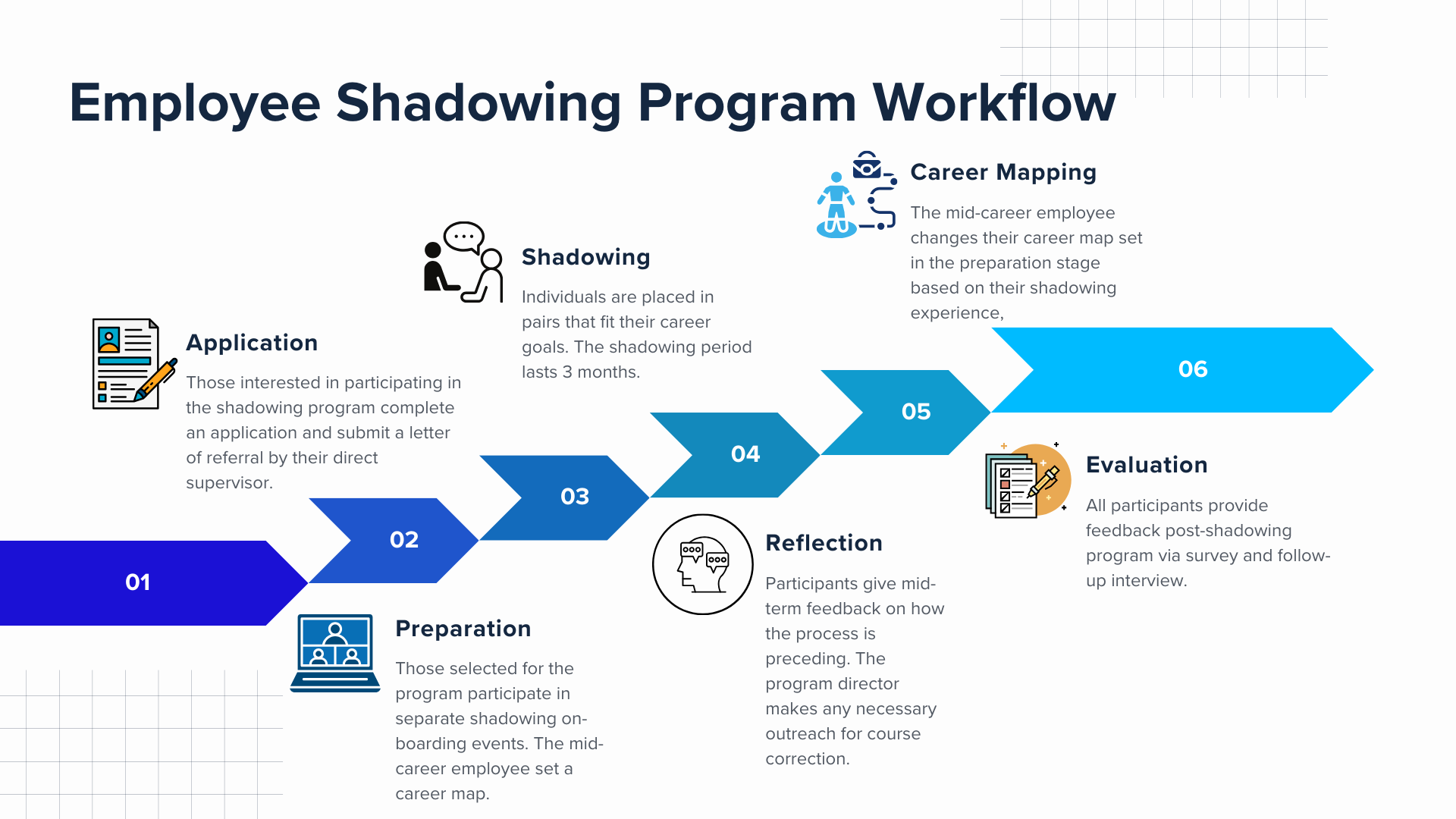
This diagram presents the end-to-end workflow of a structured employee shadowing program designed for workforce development. The visual outlines key stages from participant application and intentional pairing through observation, reflection, and post-experience evaluation, demonstrating a scalable and equitable approach to increasing transparency into senior-level roles.
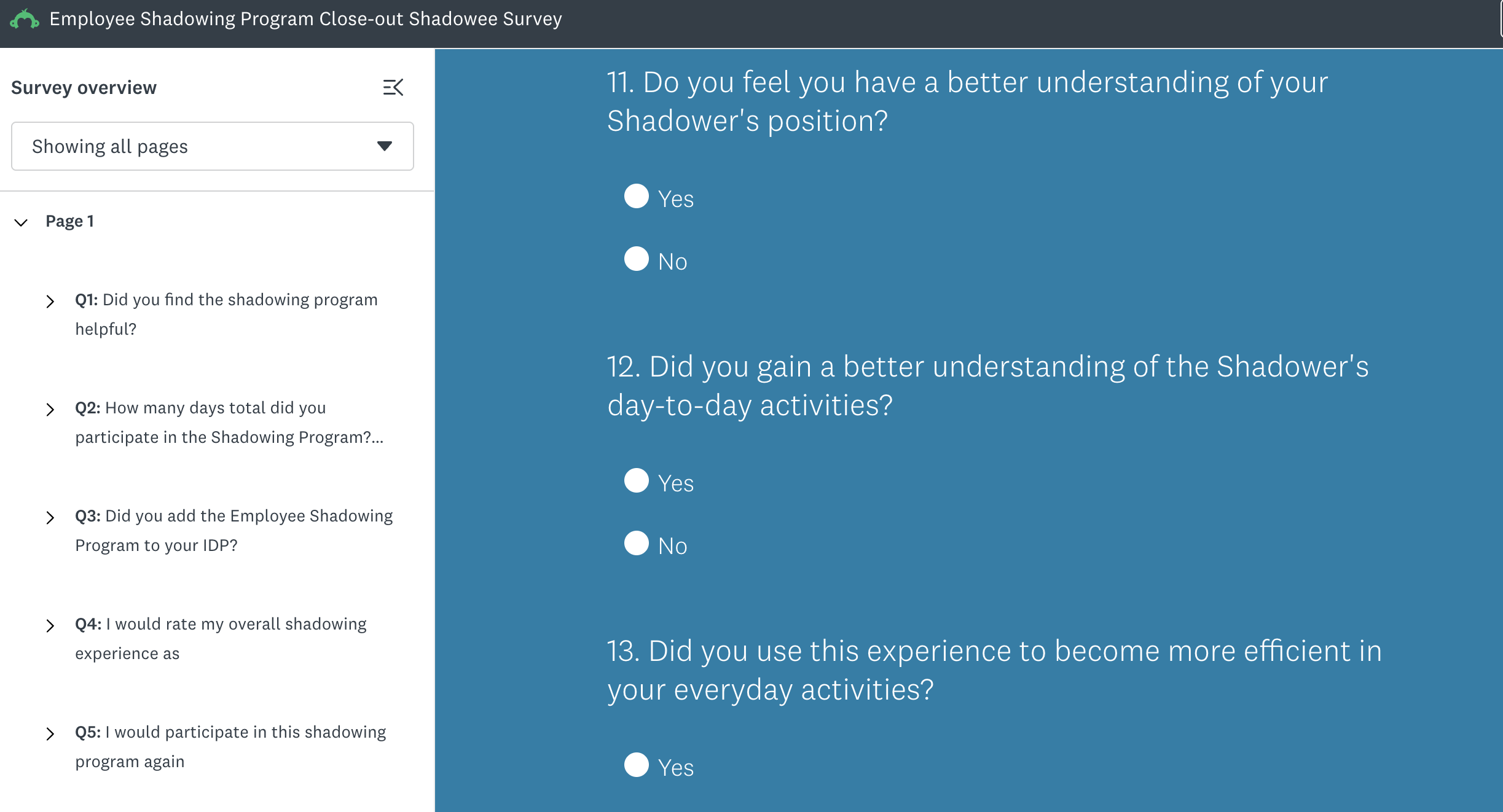
A structured close-out survey used to assess the effectiveness of the employee shadowing program. Questions measure participant understanding of leadership responsibilities, confidence in career planning, and overall experience quality, supporting data-informed improvements to leadership pipeline and professional development initiatives.